Lens choice for character
What focal length actually controls when you're shooting character work — face rendering, room visibility, and the emotional distance between camera and subject. The same scene at four lenses, and how to pick.
Lens choice is one of the few decisions in filmmaking where the math and the emotion are the same conversation. The number on the side of the barrel — 24, 35, 50, 85, 135 — controls all three of the things the audience reads from a face on screen: how the face itself is rendered, how much room is in the frame around it, and how close the camera feels to the subject regardless of how close it actually is.
This page covers what those four lenses actually do, why they look different even when framed identically, and how to pick. The walk-through uses character work — dialogue, portraits, singles — because that's where focal length matters most. For the wider conversation about how a scene cuts together, the dialogue 2-shot guide covers the geometry that has to hold across whatever lens you're on.
A wider lens shows the room. A longer lens shows the face. The number on the barrel is the trade.
What focal length actually controls
Three things, all linked.
Field of view
How much of the world fits in the frame. Wider lens, more world. This is the obvious one and the one most people stop at — but it's the least interesting of the three for character work.
Apparent perspective
How rounded or flat the face renders, and how depth is compressed or expanded. A 24mm lens at conversational distance gives you a face that's geometrically wider toward the camera and narrower toward the back of the head — the classic "wide-lens hatchet face." An 85mm lens at the same framing flattens that, because the camera has to be three times farther back to fill the same frame, and the geometric difference between the front and back of the face becomes proportionally tiny.
Depth of field at any given framing
For the same composition (same head size in frame), a longer lens gives you a shallower depth of field than a wider one. That's the optical reason 85mm portraits feel "creamy" and 24mm wide shots feel sharp front-to-back. It is not the lens being inherently soft or sharp — it's the geometry forcing a different working distance and aperture relationship.
Field of view is the obvious lever. The other two are the ones that decide whether your scene reads as a portrait, a documentary, a fever dream, or surveillance.
The lenses, in order
Full-frame equivalents. If you're on a Super 35 or APS-C sensor, the same focal length renders narrower because of the crop factor — multiply by roughly 1.5 to get the equivalent.
| Focal length | What it does | Where it fits |
|---|---|---|
| 24mm | Very wide. Distorts faces if the camera is close. Backgrounds stay sharp and present. | Establishing shots. Action where the room is part of the story. Singles where the world is closing in on the subject. |
| 35mm | The naturalistic indie default. Shows the room without warping the face. | Dialogue 2-shots, walking-and-talking, scenes where the location is doing work. |
| 50mm | Closest to natural human vision. Faces flatten slightly, backgrounds compress slightly. Safe. | Classical dialogue. Cleans, OTS, anywhere you want the lens to disappear. |
| 85mm | The portrait lens. Backgrounds soften into texture. Faces flatten further. Subject feels separated from the world. | Emotional emphasis. Singles where the face is the entire scene. Reaction shots. |
| 135mm and up | Strong compression. Backgrounds dissolve. Subject feels watched, dreamed about, or pulled forward in time. | Surveillance. Heightened emotional moments. Specific stylistic effects. |
Anamorphic lenses behave like wider lenses with the field-of-view of longer ones, plus oval bokeh and horizontal flares — they're a different conversation. The numbers above are spherical equivalents.
How focal length renders the face
The most useful intuition for lens choice on character work is this: framing a face the same size on screen with a wider lens means the camera has to be closer. A closer camera means a larger geometric difference between the tip of the nose and the back of the ear. That ratio is what your eye reads as "rounded" or "flat" — and the audience reads it as emotional distance, not as optics.
At a medium close-up framing:
- 24mm puts the camera about 3 feet from the subject's face. The nose-to-ear ratio is dramatic. Faces read large, immediate, and slightly grotesque if the actor isn't framed carefully.
- 35mm puts the camera around 4–5 feet away. Mild but noticeable shaping. Reads natural for indie work; reads slightly stylized for prestige drama.
- 50mm puts the camera around 6–7 feet away. Face renders close to how the eye sees it in person. Reads neutral.
- 85mm puts the camera around 10–12 feet away. Face is flat, backgrounds peel into shallow focus, the subject is held in optical isolation.
- 135mm puts the camera 16+ feet away. The relationship between camera and subject becomes one of observation, not participation.
Notice that nothing in that list is about how "good" or "bad" any of these look. The 24mm hatchet face is the right rendering for a character about to commit a crime in a confined space. The 135mm flat-face is the right rendering for someone observed from across a room they don't know they're in. The lens isn't the answer — the question is what relationship you want the camera to have with the subject.

Watch on YouTube → · Shot Angles · 3:29 · Previs Pro Shot School
The right lens for what you're doing
Defaults that hold up across most indie character work.
- Dialogue scenes in real locations — 35mm. Wide enough to keep the room in frame, narrow enough that faces don't warp.
- Classical, room-agnostic dialogue — 50mm. The lens disappears, the conversation lands.
- Reaction shots and emotional singles — 85mm. Optical isolation does the emotional work.
- Big-room establishing shots that include character — 24mm or 35mm depending on how close the character can get to the lens before warping.
- Surveillance, dream, observed-from-outside — 135mm or longer. The audience reads distance.
- Anything with motion through space — wider rather than longer. A 24mm Steadicam holds frame on a moving subject; an 85mm Steadicam looks like a tennis match.
Common mistakes
- Shooting every scene at 50mm because it's "natural." Naturalism is a choice, not a default. If every dialogue, reaction, and reveal looks the same, you've made the lens invisible at the cost of the storytelling.
- Shooting close-ups at wide focal lengths. 24mm at 18 inches is a horror-movie choice. If you want a tight close-up that doesn't warp, the camera goes back and the lens goes longer.
- Shooting wide masters at long lenses. 85mm wide masters compress the room into a wallpaper smear. The location is no longer part of the shot — which means you've paid for a location for no reason.
- Treating "shallow depth of field" as a stylistic choice independent of lens. Shallow DoF on character work usually means a long lens at a close working distance. That comes with face flattening and background compression. You're not just changing the bokeh — you're changing the relationship between camera and subject.
- Ignoring sensor size. 35mm on a Super 35 sensor frames roughly like a 50mm on full-frame. If you're cutting between cameras with different sensors, the lens labeling can lie about what the audience sees.
Try the same scene at four lenses
Block it once, swap the lens
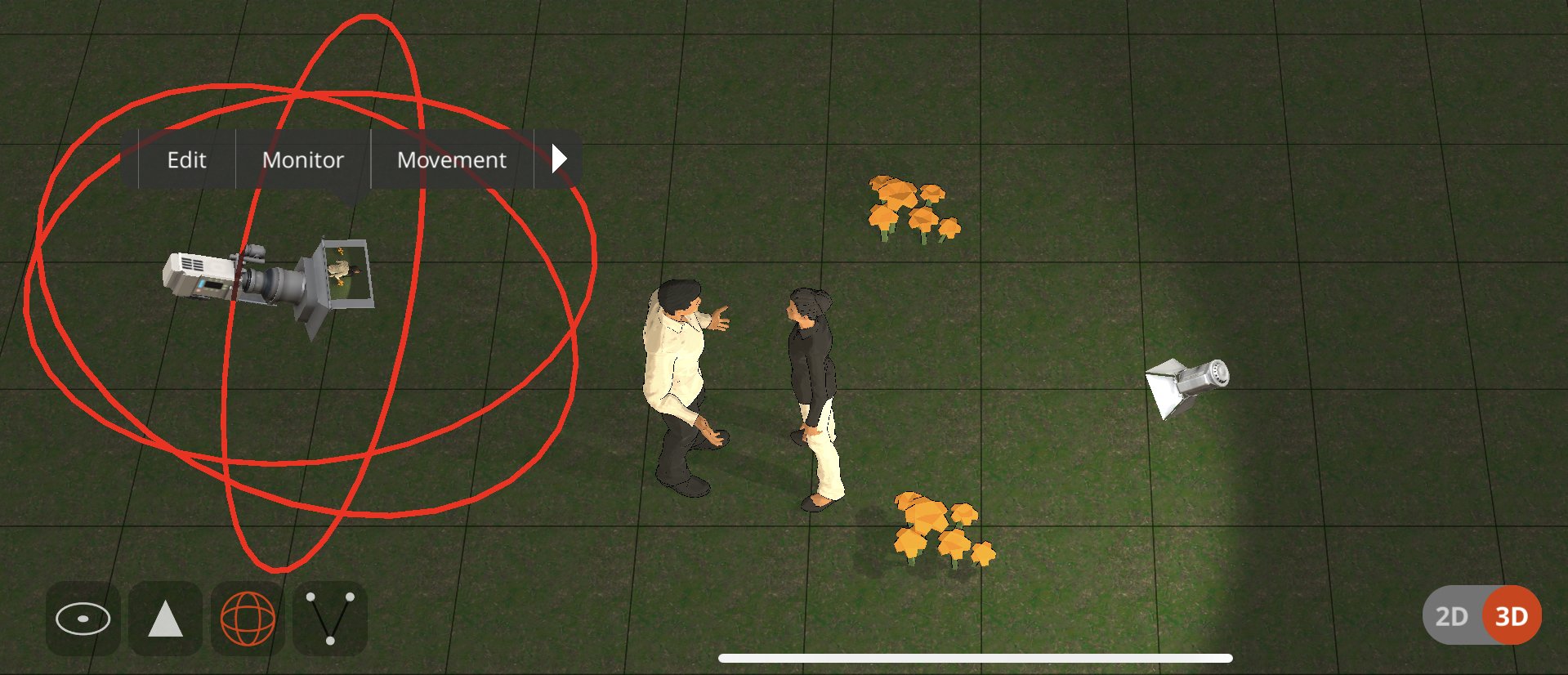
Set up a single scene in Previs Pro — two characters, a room, one camera. Swap the lens from 35 to 50 to 85 and watch the geometry respond in real time. The camera moves to maintain framing, the face rendering shifts, and the depth of field re-renders against the same actors. Five minutes in the app saves you a lensing argument on the day.
The free tier opens with full 3D blocking, AI generation, and the editorial timeline. Exports carry our watermark until you upgrade; the lens choice is unlocked from the start.
If you're still picking a previs tool for this kind of work, our comparison of nine previs and storyboarding tools covers what each one does and where each one stops.
Fix it in pre. 🎬